When designing or analyzing components, understanding a material’s mechanical properties is essential for predicting performance under load, stress, and environmental conditions.
Engineers frequently rely on a set of core equations to calculate properties such as Young’s modulus, bulk modulus, shear modulus, and Poisson’s ratio—each offering insight into stiffness, elasticity, and volumetric behavior.

This quick-reference guide compiles the most commonly used formulas in one place, making it easier to validate material choices, optimize designs, and ensure compliance with industry standards. Whether you’re working on aerospace components, medical devices, or industrial machinery, these equations are fundamental tools for accurate engineering analysis.
Young’s Modulus
Young’s modulus quantifies a material’s stiffness under axial loading. It defines the linear relationship between stress and strain in the elastic region.
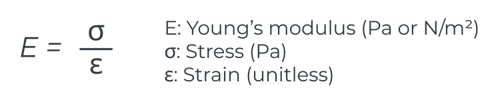
A high modulus means the material resists deformation (e.g., tungsten), while a low modulus indicates flexibility (e.g., elastomers). It governs how much a material stretches under load before permanent deformation.
Practical Example
A steel rod elongates 1 mm under a 100 MPa tensile stress. If the strain is 0.0005:

This matches the known modulus of structural steel.
Shear Modulus
Shear modulus, also known as the modulus of rigidity, defines a material’s resistance to shear deformation. It’s the ratio of shear stress to shear strain.

It governs how a material deforms when subjected to tangential forces. For isotropic materials, it’s derived from Young’s modulus and Poisson’s ratio.
Practical Example
A polymer layer under 50 N shear force across 0.005 m² with a shear strain of 0.05:

This low value reflects the material’s softness.
Bulk Modulus
Bulk modulus measures a material’s resistance to uniform compression. It’s the ratio of pressure change to relative volume change.
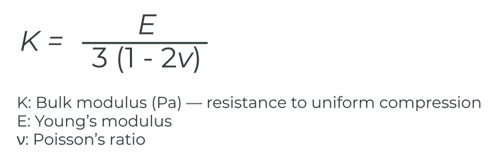
High bulk modulus materials (e.g., metals) resist volume change under pressure. It’s critical in hydrostatics and pressure vessel design.
Practical Example
A fluid compresses by 0.001 m³ under 2 MPa pressure:

Poisson’s Ratio
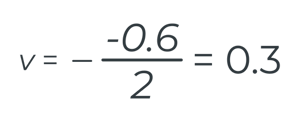
Poisson’s ratio is the negative ratio of lateral strain to axial strain. It describes how materials contract laterally when stretched.
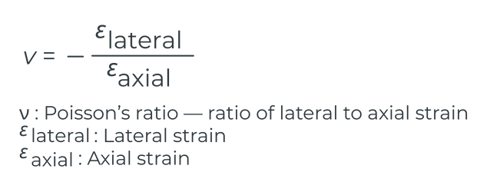
Most metals have ν ≈ 0.3. Rubber approaches 0.5 (incompressible), while cork is near 0 (minimal lateral expansion).
Practical Example
A rod elongates 2 mm and contracts 0.6 mm laterally:
Normal Stress
Stress is the internal force per unit area. It’s the primary measure of load intensity in structural and mechanical components.

Stress determines whether a material will deform, yield, or fracture. It’s directional—tensile or compressive.
Practical Example
A shaft under 15,000 N load with a 0.001 m² cross-section:

Strain
Strain is the measure of deformation—how much a material stretches or compresses relative to its original length.
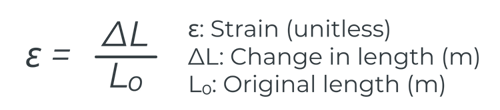
Strain is unitless and can be elastic (recoverable) or plastic (permanent). It’s critical in determining material behavior under load.
Practical Example
A beam elongates 3 mm over a 1.5 m length:

Von Mises Stress
Von Mises stress is a scalar value used to predict yielding of ductile materials under complex loading. It combines principal stresses into a single equivalent stress.
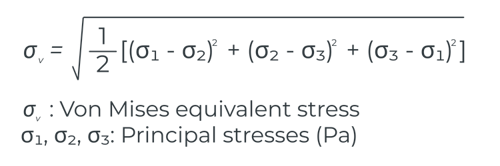
If Von Mises stress exceeds the yield strength, plastic deformation begins. It’s widely used in FEA and design validation.
Practical Example
Given principal stresses: σ₁ = 120 MPa, σ₂ = 60 MPa, σ₃ = 0 MPa:

Hooke’s Law
Hooke’s Law describes the linear relationship between stress and strain in elastic materials. It’s valid up to the proportional limit.

It governs elastic deformation. Beyond this limit, materials may yield or fracture.
Practical Example
If a polymer has a strain of 0.01 and Young’s modulus of 5 MPa:

Toughness
Toughness is the total energy a material can absorb before fracturing. It’s the area under the stress-strain curve.
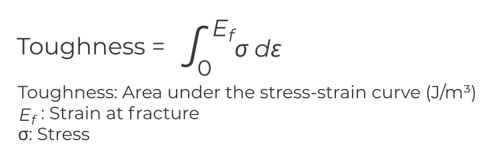
High toughness materials resist impact and deformation. Brittle materials have low toughness.
Practical Example
A steel sample absorbs 6 MJ/m³ before fracture:

Hardness
Hardness measures a material’s resistance to indentation. It’s often correlated empirically with yield strength. Harder materials resist wear and surface damage. Different tests yield different values (Brinell, Rockwell, Vickers).

Practical Example
If yield strength is 350 MPa and test constant is 3:

Creep
Creep is the slow, progressive deformation of materials under constant stress over time, especially at elevated temperatures.
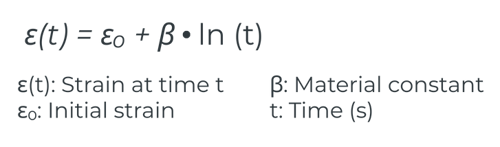
Creep is critical in high-temperature applications like turbines and boilers. It progresses in three stages: primary, secondary, tertiary.
Practical Example
Initial strain = 0.01, creep constant β = 0.002, time = 1000 s:

Fatigue Life
Fatigue life, also known as Basquin’s Law, models the relationship between stress amplitude and number of cycles to failure under cyclic loading.

Fatigue failure occurs below yield strength. It’s critical in rotating machinery, welded joints, and cyclic-loaded components.
Practical Example
σ′_f = 900 MPa, b = -0.12, N = 10⁶ cycles:

 Amanda White