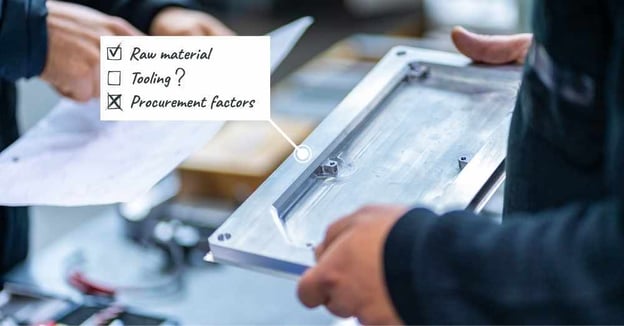
It’s easy to view material cost as the primary driver of part cost. After all, aluminum is cheaper per pound than stainless steel, which is cheaper than titanium, which is cheaper than most superalloys.
But raw stock is usually the smallest portion of the overall cost of a machined part, and material choice is one of the earliest and most powerful levers for controlling manufacturability and long-term costs.
Related Read: Material Selection Strategy for Machined Components
Machining time, tooling, scrap, quality control requirements, and finishing operations all typically outweigh the cost of the material itself. That means choosing cheap but difficult‑to‑machine material often results in a more expensive part overall.
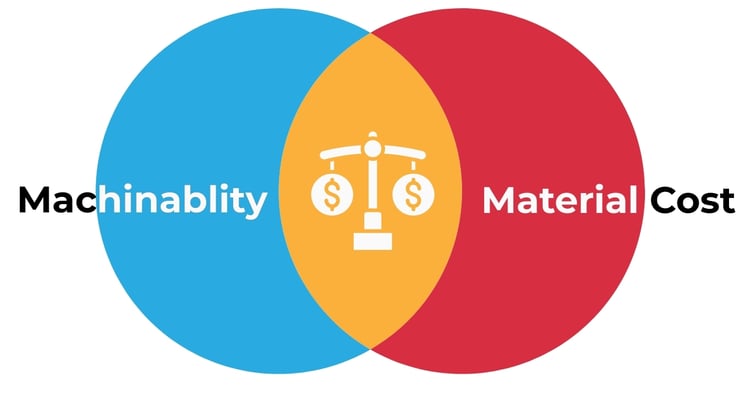
For example, a low‑cost stainless steel may seem appealing early on. But once you factor in lower machinability ratings, increased tool wear, longer cycle times, potential work hardening, and tighter inspection requirements, the total cost can exceed a more expensive—but easier‑to‑machine—material like aluminum.
A well‑selected material can reduce cycle time, improve surface quality, minimize tool wear, speed up inspection, and even reduce lead time. A poorly chosen one does the opposite—and sometimes forces redesign late in the process.
Let’s walk through what factors engineers should consider in the early stages of design to optimize both material cost and machinability, helping you avoid surprises when the part hits the shop floor.
Machinability - the Hidden Cost Multiplier
Machinability influences cost more than almost any material property. It affects spindle speeds, feed rates, tool life, workholding approach, heat generation, chip formation, and the risk of dimensional instability. Even small differences can compound across operations like roughing, finishing, drilling, tapping, and pocketing.
Materials with higher machinability (such as 6061 aluminum or free‑machining brass) allow faster cycle times and reduce the likelihood of scrap or deviation from tolerance. This is especially valuable when the design calls for fine features, deep pockets, thin walls, or tight GD&T controls.
Conversely, materials like titanium or certain stainless steels demand slower speeds, specialized tooling, and more conservative tool paths. These factors significantly increase the cost of each part, even though the raw stock may be well‑priced relative to performance.
| Material | Typical Use Case | Material Cost | Machinability | Notes |
| 6061 Aluminum | General‑purpose structural parts, enclosures, fixtures | Low | High | Great default choice: low cost, very machinable, wide availability, good strength/weight. |
| 7075 Aluminum | High‑strength aerospace, performance parts | Medium | Medium | Stronger than 6061 but harder to machine and more expensive; reserve for high‑load designs. |
| 1018 / 1020 Mild Steel | General mechanical components, shafts, brackets | Low | Medium-High | Cheap and fairly machinable; heavier than aluminum and may need coating for corrosion. |
| 4140 Alloy Steel | High‑strength mechanical parts, tooling, wear components | Medium | Medium-Low | Heat‑treatable and tough; machinability drops as hardness goes up, so costs rise in finishing. |
| 304 Stainless Steel |
Corrosion‑resistant hardware, food/consumer/industrial parts |
Medium | Low |
Good corrosion resistance but relatively poor machinability; slower cuts and more tool wear. |
| 316 Stainless Steel | Aggressive environments, marine, chemical | High | Low | Better corrosion resistance than 304, even more expensive and demanding to machine. |
| 360 Brass | Fittings, connectors, aesthetic components, precision fasteners | Medium | Very High | One of the easiest metals to machine; ideal when tight tolerances and fine features matter. |
| Copper | Thermal/electrical components | High | Low-Medium | Excellent conductivity but gummy to machine; chip control and heat can become issues. |
| Titanium | High-performance aerospace, medical, high-temp/strength parts | Very High | Very Low | Top‑tier performance with bottom‑tier machinability; use only when the application truly needs it. |
| Delrin (POM/Acetal) |
Precision plastic parts, bushings, and low‑friction mechanisms |
Low-Medium | High |
Machines very well with proper workholding; great for prototypes and production where plastic works. |
Optimizing early for machinability means understanding not just whether the material can meet performance requirements, but how easily it can be shaped into the required geometry.
Matching Material Performance to Real Requirements
While concern for a material’s machinability can go understated in the design phase and incur downstream costs, the inverse can also occur. Engineers often reach for the strongest, most corrosion-resistant, or most temperature-stable material “just to be safe,” especially when a product’s operating environment isn’t fully defined yet; but the safe choice may not be the smartest or most cost-effective one.
In addition to a higher cost, high-performing materials also often carry machining challenges that multiply downstream: slower feeds and speeds, increased tool wear, stricter fixturing needs, and specialized cutting strategies. All of these factors increase cost long before the first part ships.
Related Read: What to Consider when Calculating Material Cost
A smarter approach is to match material performance to actual design requirements, not assumed ones. That begins with clarifying the real constraints of the application.
If a part is operating indoors, away from corrosive environments, stainless steel may be unnecessary.
If loads are moderate, a high-strength alloy steel may be overkill compared to a mild steel or heat-treated aluminum.
If thermal stability isn’t mission-critical, engineering plastics may provide the same function at a fraction of the machining time and cost.
This isn’t just about cutting costs—it’s about choosing a material that supports both function and manufacturability. Under-specifying can be a risk, but over-specifying creates unnecessary complexity that reverberates through machining, inspection, and even downstream processes like finishing or assembly.
The key is understanding what your part must do, what it might encounter, and what risks truly need to be mitigated.
Another factor engineers often overlook is how material choice interacts with geometry. For instance, a thin‑walled titanium part imposes radically different machining challenges than a similar geometry in aluminum. The material magnifies the difficulty of the geometry, often pushing a design from “challenging but manageable” into “slow, expensive, and likely to fail quality checks.” Aligning material properties with expected tolerances, wall thicknesses, surface finishes, and load paths gives engineers far more predictable machining outcomes.
By grounding material selection in real performance needs, environmental conditions, and geometric implications, engineers can avoid unnecessary manufacturing burdens and design parts that are both robust and economically sound.
Final Thoughts
When you evaluate both raw cost and machinability from the beginning, you reduce risk, improve quality, and avoid surprises once the part reaches production. The optimal material is rarely the cheapest—and rarely the strongest or hardest. It’s the one that delivers the required performance at the lowest total manufacturing cost.
The goal isn’t to avoid challenging materials altogether but to be deliberate in choosing them. When high performance is truly necessary—like in aerospace, medical, or high‑temperature environments—machinability challenges are expected. But in commercial or industrial applications where performance ranges are wider, selecting a moderately priced, highly machinable material often provides the best combination of quality, speed, and cost efficiency.
Engineers who treat material choice as a primary design variable rather than a late‑stage administrative detail tend to produce parts that are more manufacturable, more affordable, and more consistent in quality.

 Amanda White