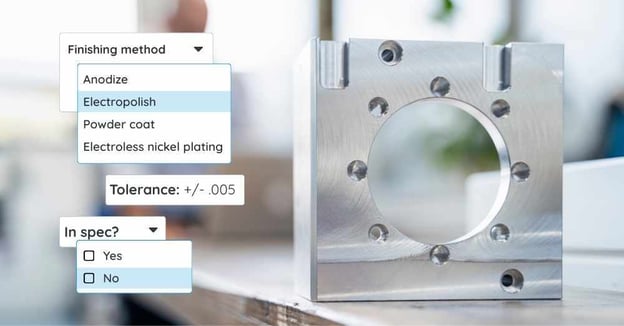
Surface finishing is a design variable that directly affects part performance, dimensional compliance, fatigue behavior, corrosion resistance, cleanability, and validation risk.
For aerospace and medical device OEMs, post‑machining processes must be intentionally selected and clearly specified—otherwise, finishing can become an uncontrolled variable that increases both risk, quality, cost, and lead times.
A Note on Surface Integrity
Surface integrity is measurable and controllable, but it requires moving beyond basic metrics like Ra.

While Ra captures average roughness, it ignores waviness, lay, and microstructural anomalies that influence fatigue and corrosion.
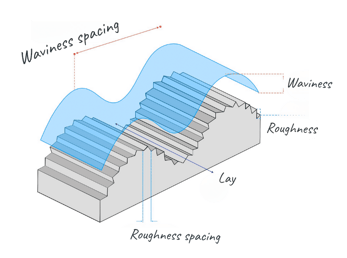
A common failure mode is specifying a surface roughness requirement on a drawing without considering how that surface will actually be produced or modified after machining. CNC machining alone rarely produces the final surface condition seen by the end user.
Bead blasting, tumbling, polishing, anodizing, passivation, and other finishing methods all modify surface topography and, in many cases, part geometry. If these processes are not accounted for during design, engineers often discover too late that a compliant Ra value does not correlate with acceptable functional performance or dimensional stability.
Material Conversion Processes
Passivation
Added Lead Time: 2 - 5 days | Added Cost: 5 - 15%
Passivation is commonly misunderstood as a surface finishing process when, in reality, it primarily modifies surface chemistry rather than surface topography.
Passivation improves corrosion resistance by enhancing the oxide layer on stainless steels but does not significantly change surface roughness or geometry.
This makes it a low‑risk process for tight‑tolerance components, provided it is specified and verified in accordance with ASTM A967 or AMS 2700.
Chromate Conversion (Chem-Film)
Added Lead Time: 3 - 7 days | Added Cost: 10 - 25%
Chromate conversion coatings, commonly referred to as chem film, are frequently applied to aluminum parts where corrosion resistance and electrical conductivity are required without significant dimensional change. Unlike anodize, chem film produces a very thin conversion layer that preserves base material geometry and surface roughness.
This makes chem film particularly well-suited for aerospace components requiring bonding, grounding, or mating interfaces where anodize would be problematic. However, chem film provides less wear resistance and durability than anodizing and can be susceptible to damage during handling if not properly controlled.
Engineers should clearly specify chem film type and class (e.g., MIL‑DTL‑5541 or equivalent) and ensure downstream processes—such as assembly or cleaning—do not compromise the conversion layer. While low risk dimensionally, chem film still requires intentional specification to ensure consistent performance.
Black Oxide
Added Lead Time: 1 - 3 days | Added Cost: 5 - 10%
Black oxide is a conversion coating primarily used on carbon steel components to reduce glare, improve appearance, and provide mild corrosion resistance. From a dimensional standpoint, black oxide adds negligible thickness and does not meaningfully alter surface roughness or geometry.
That low-dimensional impact makes black oxide attractive for tight tolerance components, but engineers should be careful not to overestimate its functional contribution. Black oxide provides minimal standalone corrosion protection and offers no improvement in wear resistance or fatigue performance. In aerospace and medical environments where parts may see aggressive cleaning, sterilization, or humid storage conditions, black oxide is often insufficient unless supplemented by controlled lubrication or environmental protection.
Designers should treat black oxide as a cosmetic or handling aid rather than a performance-enhancing finish and ensure corrosion assumptions align with actual service conditions.
Material Removal Processes
Bead Blasting
Added Lead Time: 1 - 3 days | Added Cost: 5 - 15%
Bead blasting is frequently selected to improve cosmetic appearance and reduce visible tool marks, particularly on aluminum and stainless steel housings. While bead blasting is often described as “non‑dimensional,” in practice it induces micro‑level material removal and edge rounding.
On fatigue‑sensitive aerospace components, this can either be beneficial or detrimental depending on how the process is controlled. Uniform compressive stress can improve fatigue performance, but uncontrolled blasting pressure, media size, or exposure time can degrade sharp edges, blur datum features, and obscure inspection results.
Vibratory Deburring and Tumbling
Added Lead Time: 3 - 7 days | Added Cost: 10 - 25%
Vibratory tumbling and mass finishing introduce even greater dimensional considerations. These processes are excellent for removing burrs and producing consistent edge radii across batches of parts, but they remove material in a geometry‑dependent manner. Holes grow, edges soften, and small features may blend into surrounding surfaces.
For parts with tight positional tolerances or functional edges—such as sealing interfaces or mating features—tumbling must be explicitly accounted for in both tolerance allocation and inspection planning. Without that foresight, engineers often face nonconformances that technically meet surface finish requirements but violate functional intent.
Polishing
Added Lead Time: 3 - 10 days | Added Cost: 20 - 60%
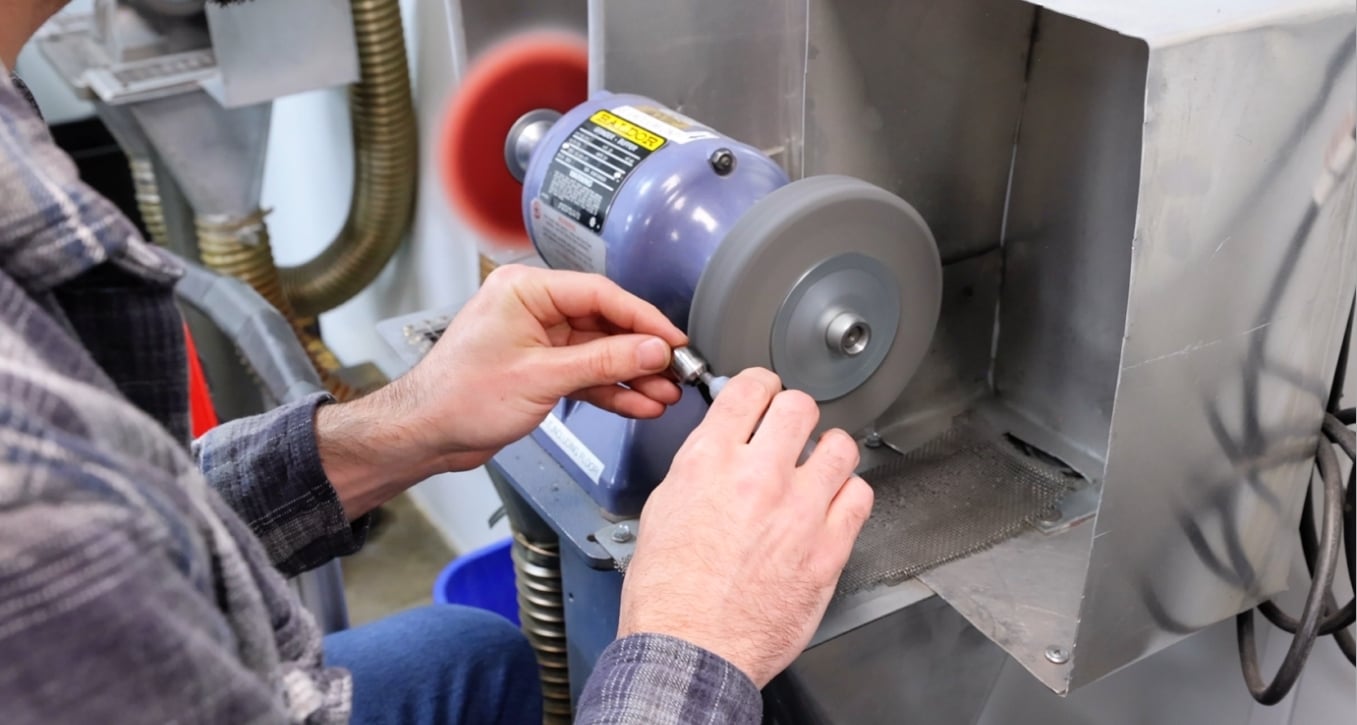
Mechanical polishing and electropolishing are often grouped together because both reduce surface roughness, but they behave very differently from a design standpoint.
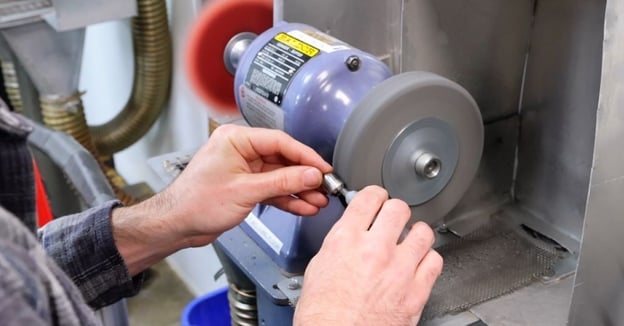
Mechanical polishing relies on abrasive contact and is highly operator‑dependent, producing directional surface textures and non‑uniform material removal.
Electropolishing, by contrast, removes surface material electrochemically and preferentially attacks surface peaks, resulting in a more isotropic surface texture.
For medical device components where cleanability, corrosion resistance, and biocompatibility are critical, electropolishing is often preferred—but engineers must still account for predictable dimensional change, particularly on thin walls and internal features.
Material Addition Processes
Anodize
Added Lead Time: 5 - 14 days | Added Cost: 20 - 70%
Anodizing is widely used on aluminum components to improve corrosion resistance, wear performance, and cosmetic appearance. Unlike many mechanical finishes, anodizing grows an oxide layer from the base material rather than depositing a coating on top.
This oxide growth has direct dimensional implications. A portion of the anodic layer penetrates into the base material while the remainder builds outward, effectively changing part dimensions—particularly on holes, threads, and precision interfaces. Hardcoat anodize further amplifies these effects due to increased thickness and hardness.
For aerospace and medical device applications, anodize needs to be considered during tolerance allocation. Engineers should specify anodize type, class, thickness, sealing requirements, and masking expectations on the drawing. Failing to do so often leads to fit issues, thread interference, or unexpected inspection failures that are discovered late in the manufacturing cycle.
Plating
Added Lead Time: 7 - 14 days | Added Cost: 30 - 80%
Electroplating processes—such as nickel, chrome, zinc, or precious metal plating—are used to enhance corrosion resistance, electrical conductivity, wear resistance, or solderability. Unlike conversion coatings, plating adds material to the surface, making thickness control a critical design consideration.
Plating thickness varies with geometry, current density, and part orientation. Sharp edges tend to build more rapidly, while recessed features may plate thin or inconsistently. This non-uniformity can affect fit, fatigue performance, and contact resistance if not properly specified and controlled.
For high reliability applications, engineers should specify plating thickness ranges, allowable buildup, post-plate machining allowances if required, and applicable standards (e.g., AMS, ASTM). Plating should be considered part of the dimensional stack up—not a cosmetic afterthought.
Powder Coating
Added Lead Time: 7 - 14 days | Added Cost: 25 - 60%
Powder coating provides excellent cosmetic durability and corrosion resistance for housings, frames, and non precision structural components. However, it is one of the most dimensionally impactful finishing processes commonly applied to machined parts.
Powder coat thickness is significantly greater and less uniform than most chemical or conversion finishes. Edges round aggressively, corners build unevenly, and internal features such as slots or holes can quickly move out of tolerance if not masked. Post coat rework is difficult and often impossible without compromising coating integrity.
As a result, powder coating should be avoided on components with tight GD&T requirements, critical interfaces, or functional sealing surfaces. When it is used, engineers should explicitly define no coat zones, masking requirements, and inspection criteria rather than assuming suppliers will infer functional intent from geometry alone.
The common thread across all finishing categories is that surface finish decisions cannot be safely deferred to suppliers or resolved through RFIs. Once a part is machined, many finishing-related risks are already locked in.
High-performing aerospace and medical device teams treat surface finishing as part of the engineered solution—evaluated alongside material selection, GD&T, inspection strategy, and validation planning. By understanding whether a finish removes material, adds material, or converts surface chemistry, engineers can make intentional tradeoffs that reduce risk, control cost, and improve functional reliability.
Surface finish is not a post‑process detail. It is a design variable—and should be treated with the same rigor as any other critical requirement on the drawing.
 Amanda White