Surface finishing, particularly when it involves material removal, is a design consideration, not just a cosmetic operation. Although the impact typically can’t be seen by the naked eye, subtractive surface finishing methods impact a part’s final dimensional integrity and performance.
For engineers responsible for specifying geometry, tolerances, and functional requirements, this distinction matters. Unlike additive processes such as anodizing or plating, subtractive finishing methods actively remove material from the part. Edges are softened, peaks are abraded, and surfaces evolve in ways that are inherently dependent on geometry, accessibility, and process dynamics.
The implication is straightforward but often overlooked: surface finishing must be incorporated into design intent from the outset. This article examines three of the most common subtractive finishing processes used for CNC machined components—tumbling, bead blasting, and polishing—and outlines how each should influence upstream design decisions.
Understanding Material-Removing Surface Finishes
Before looking at individual processes, it helps to group material‑removing finishes by mechanism: bulk abrasion, particle impact, and localized smoothing.
Tumbling relies on random part‑media contact for bulk material removal, bead blasting uses directed high‑velocity particles, and polishing is a localized, controlled process used to reach very low roughness.
Despite these differences, several unifying characteristics define subtractive finishing:
- Material removal is non-uniform and strongly dependent on geometry
- Edges and high points are preferentially affected, often leading to unintentional radiusing
- Feature accessibility governs outcomes, particularly for internal geometries
- Surface roughness evolves asymptotically, meaning improvements diminish with process time while geometric distortion risk increases
For engineers, the key takeaway is that these processes do not simply “overlay” a finish onto a part—they reshape it. The sections that follow examine how this reshaping manifests in practice.
| Attribute | Tumbling | Bead Blasting | Polishing |
| Primary Mechanism |
Random abrasive media contact
|
High-velocity particle impact
|
Localized abrasive smoothing
|
| Material Removal |
Moderate, non-uniform
|
Minimal, micro-scale
|
Low to moderate, localized
|
| Surface Roughness (Ra) |
Moderate improvement (e.g., 1.6 → 0.8 µm typical)
|
Uniform matte (minimal Ra change)
|
Significant reduction (<0.2 µm achievable)
|
| Edge Impact |
Strong edge rounding (inherent)
|
Slight softening
|
Moderate to aggressive rounding possible
|
| Dimensional Control |
Low predictability on tight tolerances
|
Generally stable, but not negligible
|
Low in manual processes
|
| Uniformity |
Medium (geometry-dependent)
|
High on exposed surfaces
|
Low–medium (operator dependent)
|
| Accessibility Limits |
Poor for internal features
|
Line-of-sight limited
|
Tool access limited
|
| Process Variability |
Low–moderate
|
Low
|
High (manual influence)
|
| Typical Use Cases |
Deburring, edge conditioning
|
Cosmetic matte finishes
|
Sealing surfaces, optics, low friction
|
| Risk to Critical Features |
High (edges, thin sections)
|
Moderate (if unmasked)
|
High (geometry distortion)
|
Tumbling
Tumbling (or vibratory finishing) is widely used for general deburring and surface homogenization, submerging parts in abrasive media and using motion to gradually smooth surfaces and break edges.
Tumbling is inherently stochastic: there is no controlled toolpath or directed energy, only millions of small, random contacts. Material removal is broadly distributed but locally unpredictable, even when the finish looks uniform overall.
This has several important implications for design.
Tumbling inherently conflicts with sharp edges: exposed edges are preferentially abraded toward a radius set by media, time, and geometry. Specifying “sharp edges” alongside tumbling creates contradictory intent. A better approach is to define acceptable edge conditions—via radii or break-edge callouts—that match expected process results.
Second, non-uniform material removal complicates tolerance management. Even small amounts of removal are uneven: external profiles, thin sections, and high-aspect-ratio features can shrink disproportionately. Tight-tolerance designs should include finishing allowances or, at minimum, confirm that tolerances are still achievable after tumbling.
Finally, tumbling raises issues of access and robustness. Deep pockets, blind holes, and internal threads are partially shielded, leading to incomplete finishing, while thin walls or delicate features can be damaged by part-to-part contact. These are inherent to the process and must be addressed at the design stage.
Tumbling is best leveraged where its strengths align with design intent: deburring, edge conditioning, and general surface blending in non-critical regions.
Bead Blasting
Where tumbling is stochastic, bead blasting is directional. Pressurized media is aimed at the surface, allowing operators to target specific areas and produce a controlled cosmetic finish and surface preparation.
The assumption that bead blasting is “non-dimensional” often drives avoidable design errors. Although it removes less material than tumbling or polishing, it still modifies the surface at a micro-scale. For many features this is negligible, but for precision interfaces—such as sealing lands, bearing fits, or threaded engagements—even slight surface change can impact performance.
Engineers should use bead blasting selectively. Mask or exclude critical features, and clearly document these requirements on drawings and specifications.
Another key factor is line of sight. Unlike tumbling, bead blasting cannot uniformly reach recessed or occluded features, so internal channels, deep cavities, and complex contours will show non-uniform finishes. Designs that require consistent appearance must be reconciled with these access limits.
Even with these limitations, bead blasting delivers value beyond appearance. The process can introduce compressive residual stress at the surface that, in some cases, enhances fatigue performance. It is not a replacement for controlled shot peening, but this secondary effect can be advantageous when properly characterized and applied.
Bead blasting is most effective when used deliberately: applied where accessibility is high, excluded where functionality is critical, and specified with a clear understanding of its limitations.
Polishing
Polishing plays a distinct role among subtractive finishes, used when surface roughness requirements are stringent—such as sealing, optical, or low‑friction surfaces—and is typically localized and often operator‑driven.
This combination of precision and variability introduces unique design challenges.
Fundamentally, polishing removes material from surface peaks. As roughness drops, gains slow and require more aggressive input, increasing the risk of geometric distortion—rounding edges, degrading flatness, and altering fine features.
For engineers, this highlights the need to tie surface finish directly to function. Extremely low Ra on distortion‑sensitive geometries often drives instability and unnecessary cost.
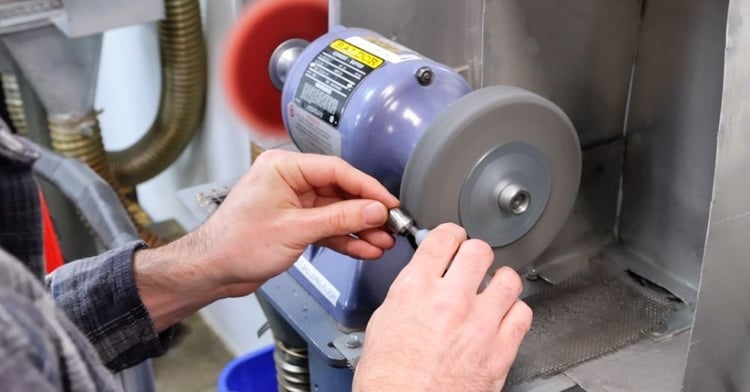
Accessibility presents a second constraint. Polishing tools—whether manual or automated—must physically contact the surface. Deep internal features, narrow grooves, and intricate geometries are inherently difficult to polish uniformly. Designs that require low roughness in such regions may need to be reconsidered or manufactured using alternative methods.
Finally, the human element cannot be ignored. Manual polishing introduces variability, even in well-controlled environments. Clear acceptance criteria, inspection methods, and communication with manufacturing teams are essential to achieving consistent results.
When applied judiciously, polishing enables surface conditions that are not achievable through machining alone. The key is to use it where it adds functional value—not as a blanket requirement.
Incorporating Surface Finish into Design Intent
While each finishing method has distinct characteristics, several cross-cutting design principles emerge when they are considered collectively.
Include finishing in tolerance strategy
One of the most important is the need to incorporate finishing into tolerance analysis. Subtractive processes—even those perceived as minor—shift dimensions. Engineers should avoid designing features at the edge of allowable tolerance ranges prior to finishing. Instead, finishing should be treated as a controlled variable within the tolerance stack, with appropriate allowances defined where necessary.
Use defined radii or break-edge callouts
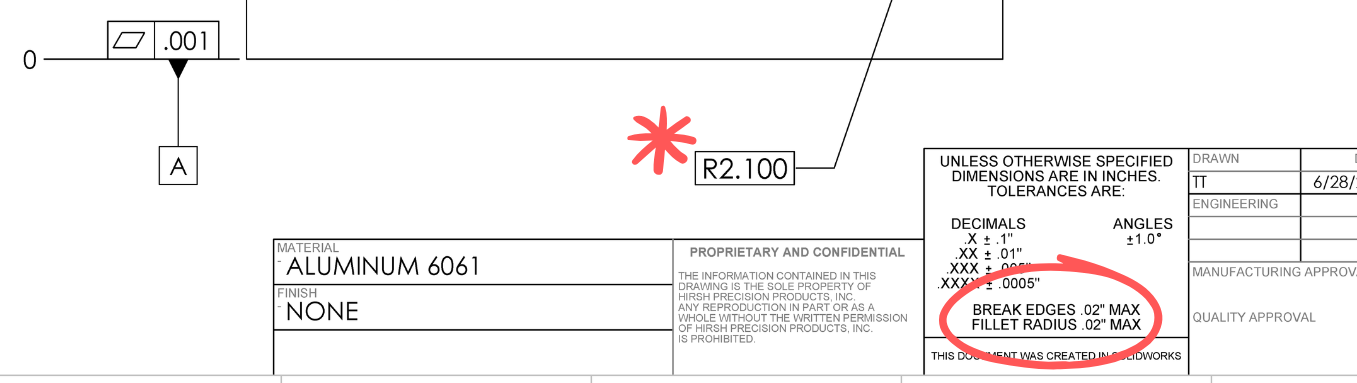
Edge design represents another common thread. All three processes discussed—tumbling, bead blasting (to a lesser extent), and polishing—tend to soften edges. Yet, engineering drawings frequently omit explicit edge specifications or rely on ambiguous language such as “sharp.” Replacing these with defined radii or break-edge callouts improves both manufacturability and consistency.
Differentiate between critical and aesthetic surfaces
Equally important is the distinction between functional and cosmetic surfaces. Not every face on a part requires the same level of finishing. By clearly identifying which surfaces are critical to performance and which are primarily aesthetic, engineers can apply finishing processes selectively, reducing cost and improving control.
Finally, feature accessibility should be evaluated as rigorously as tool accessibility in machining. If a surface cannot be reached effectively during finishing, specifying a uniform finish requirement is impractical. In some cases, this may necessitate design changes or alternative process sequences to achieve the intended result.
Final Thoughts
Many of the challenges associated with subtractive finishing stem from a small set of recurring design assumptions.
Engineers often specify tight tolerances without accounting for material removal, assume uniform finishing across complex geometries, or overlook the need for masking in processes like bead blasting. In other cases, surface roughness requirements are over-specified without clear functional justification, leading to unnecessary cost and process variability.
Addressing these issues does not require deep specialization in finishing processes. It requires a shift in mindset: treating finishing as an integral part of the manufacturing system rather than a secondary operation.

 Amanda White