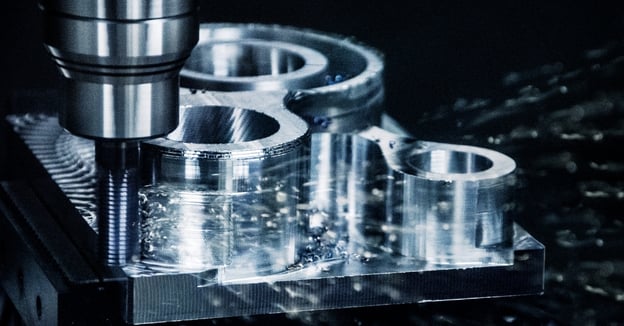
As mechanical engineers are asked to deliver more functionality in less time, CNC machining strategies have evolved to keep pace. Parts that once moved from a lathe to a mill—and sometimes back again—are now increasingly produced on machines capable of performing multiple operations in a single setup.
A multi-operation component will achieve its highest level of manufacturability if milling, turning, and live tooling decisions are considered during the design phase. If they aren’t considered until after a drawing’s been released for production, odds are you’re inadvertently introducing machining complexities and manufacturing problems that will impact lead times, scrap, and cost.
Understanding how these processes work together, and how design choices affect their efficiency, allows engineers to reduce part count, improve geometric consistency, and shorten lead times without compromising performance. When done well, multi‑operation machining simplifies manufacturing. When done poorly, it can introduce unnecessary cost, risk, and confusion.
What Defines a Multi-Operation CNC Part
A multi‑operation CNC part is one that requires both rotational and non‑rotational machining features.
These parts are often produced on mill‑turn centers or CNC lathes equipped with live tooling, Y‑axis capability, and sometimes sub‑spindles. Rather than treating turning and milling as separate steps, the machine performs them sequentially while the part remains located in a controlled, repeatable coordinate system.
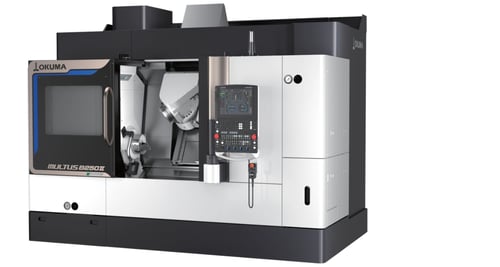
From a design perspective, these parts typically combine turned outer diameters or internal bores with milled features such as flats, slots, cross‑holes, keyways, or pockets.
What makes them distinct is not complexity alone, but the need to maintain precise relationships between features created by different cutting motions. This is where multi‑operation machining provides its greatest value.
Turning excels at producing round features that demand concentricity, roundness, and smooth surface finishes. Cylindrical geometry is created naturally by the rotation of the part, making turning the most efficient and accurate way to produce diameters, tapers, and coaxial features. When engineers require tight runout or coaxial alignment, turning is usually the preferred process.
Milling, by contrast, is better suited for prismatic geometry. Flats, pockets, contours, and complex three‑dimensional surfaces are produced through linear tool motion rather than part rotation. Milling offers tremendous flexibility, but it often requires more complex workholding when applied to round parts, especially if those parts must be removed from a lathe and re‑fixtured on a mill.
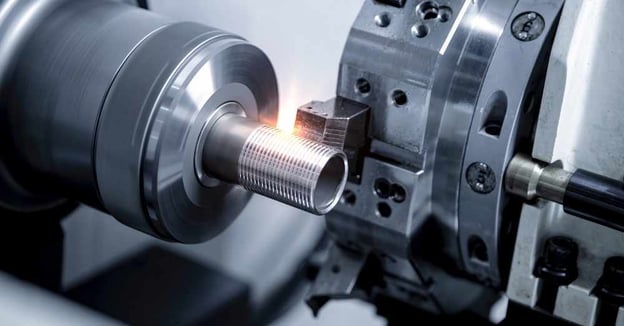
Live tooling bridges the gap between these processes. By allowing rotating tools to cut while the part remains in the lathe, live tooling enables milling operations such as cross‑drilling, slotting, and flat generation without transferring the part to another machine. This capability reduces setups and preserves positional accuracy between turned and milled features, provided the part is designed with tool access and rigidity in mind.
Not every part benefits from a multi‑operation approach. The strongest candidates are components that require precise relationships between round and non‑round features, particularly when those relationships are functional rather than cosmetic. Parts that would otherwise require multiple fixtures, secondary operations, or manual alignment steps are often good fits for mill‑turn machining.
Production volume also plays a role. While modern multi‑axis machines can produce excellent results at low volume, the real payoff typically appears when eliminating downstream operations reduces queue time, inspection effort, or assembly complexity.
On the other hand, extremely large parts, very deep milled features, or designs that push live tooling beyond its rigidity limits may be better served by separating operations.
The key point for engineers is that combining operations should be intentional. The goal is not to use advanced machines for their own sake, but to reduce variation, simplify manufacturing flow, and improve repeatability.
Improve your Multi-Operation Parts with these Design Considerations
Designing for multi‑operation machining requires careful attention to how features are oriented, referenced, and toleranced.
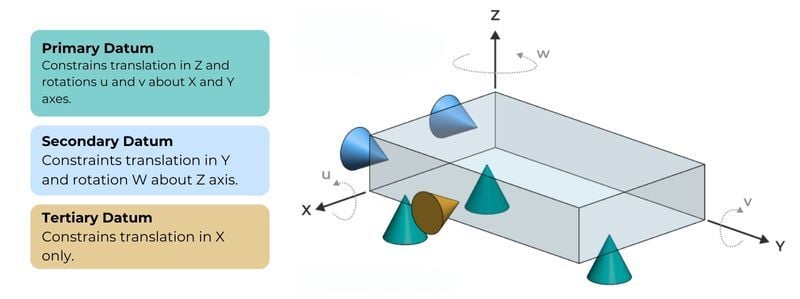
Datum selection is particularly important. When primary datums align naturally with the spindle axis or with surfaces generated early in the machining sequence, downstream features are easier to control and inspect. Conversely, datums that require re‑orientation or secondary setups increase both cost and risk.
Common Multi-Operation Design Red Flags
✔️ Features that require deep live-tool cuts or long overhands introduce rigidity problems and extended cycle times
✔️ Datum schemes that shift between turned and milled features can force additional setups or complex compensation strategies
✔️ Over-tolerancing positional relationships that aren’t functionally critical drive unnecessary cost and inspection burden
✔️ Feature placement near shoulders, flanges, or transitions that require awkward tool access
Tool access is another frequent challenge. Live tooling has limitations in reach and stiffness, especially when compared to full‑size milling spindles. Features that are too deep, too narrow, or too close to obstructions may require reduced feeds, special tooling, or additional operations. Engineers who understand these constraints can adjust feature placement or geometry slightly to achieve significant gains in manufacturability.
Tolerancing strategy often determines how straightforward or difficult it is to machine a multi-operation part. Tight tolerances should be reserved for relationships that affect function, not applied uniformly across all features. Over‑constraining positional tolerances between turned and milled features can force unnecessary process controls, longer cycle times, and more complex inspection. Apply GD&T thoughtfully—using functional datums and realistic tolerance values—so the manufacturing process can work as intended.
Workholding and part transfer must also be considered, even if they never appear on the drawing. Gripping surfaces, unfinished diameters, and transfer features can influence surface finish and dimensional stability. Leaving appropriate stock or specifying non‑critical surfaces as grip locations gives manufacturers the flexibility they need to maintain accuracy throughout the machining sequence.
Final Thoughts
Multi‑operation machining is not just an advanced machining capability. It’s a design opportunity.
When mechanical engineers understand how milling, turning, and live tooling work together, they can create parts that flow smoothly through manufacturing while meeting performance and quality requirements. Not only that, but there’s cost and lead time benefits to be gained, too.
Multi‑operation machining often reduces total cost even when the hourly machine rate is higher. Fewer setups mean less labor, less work‑in‑process, and fewer opportunities for error. Parts move through the shop faster, and inspection becomes more straightforward when critical relationships are established in a single coordinate system.
However, these benefits only materialize when the part is designed to take advantage of the process. Excessively tight tolerances, unnecessary features, or poor datum choices can negate the advantages by increasing programming complexity and cycle time. Engineers who understand this balance are better equipped to make tradeoffs that align technical requirements with manufacturing reality.
Clear communication remains one of the most powerful tools an engineer has. Drawings that identify functional relationships, critical features, and inspection priorities allow machinists and programmers to choose the most effective process. Avoiding unnecessary notes and over‑defined tolerances ensures that attention is focused where it matters most.
Early collaboration is key for multi‑operation parts. Engaging with (the right) manufacturing partners during the design phase will reveal opportunities to simplify geometry, consolidate features, and adjust tolerances before they become costly constraints.
 Amanda White